COMMONWEALTH OF MASSACHUSETTS
THE TRIAL COURT
LAND COURT DEPARTMENT
FRANCIS BEVILACQUA, III v. PABLO RODRIGUEZ
MISC 10-427157
ESSEX, ss.
August 26, 2010
Long, J.
MEMORANDUM AND ORDER DISMISSING PLAINTIFF’S COMPLAINT
Introduction
Plaintiff Francis Bevilaqua holds no title to the property at 126-128 Summer Street in Haverhill. That title is held by defendant Pablo Rodriguez. What Mr. Bevilaqua has is a quitclaim deed from US Bank, N.A., which conducted an invalid foreclosure sale on the property (it was not the holder of the mortgage at the time the sale was noticed and conducted as required by G.L. c. 244, § 14) [Note 1] and thus acquired nothing from that sale. See US Bank v. Ibanez, 17 LCR 202 (Mar. 26, 2009) & 17 LCR 679 (Oct. 14, 2009) and cases cited therein. US Bank therefore had nothing to convey, and its purported conveyance to Mr. Bevilaqua was a nullity. See Bongaards v. Millen, 440 Mass. 10 , 15 (2003).
Despite this, Mr. Bevilaqua now seeks to create a full, fee simple title in himself — quite literally, something from nothing — through the “try title” procedure of G.L. c. 240, §§ 1-5. He cannot do so, for the reasons set forth below. Accordingly, his complaint is DISMISSED in its entirety, with prejudice.
Massachusetts’ highest court will consider whether a home buyer can rightfully own a property if the bank that sold it to him didn’t have the right to foreclose on the original owner.
The state’s Supreme Judicial Court, which agreed last month to take the appeal, already ruled Jan. 7 that banks can’t foreclose on a house if they don’t own the mortgage. The lower- court decision now under review said the buyer of residential property in Haverhill, Massachusetts, never really owned it because U.S. Bancorp foreclosed before it got the mortgage.
“It appears to be the next step in the conversation,” Paul R. Collier III, who represented the borrower in the earlier case, U.S. Bank v. Ibanez, said in a phone interview.
Like the Ibanez case, the court’s decision may resonate with other states as they grapple with the rights of new homebuyers who may be hesitant to complete a purchase for fear of uncertain title, and with how such a trend may hobble the broader housing market.
Claims of wrongdoing by banks and loan servicers triggered a 50-state investigation last year into whether thousands of U.S. foreclosures were properly documented during the housing collapse. Last year, completed foreclosures in Massachusetts rose 32 percent to 12,233 from 9,269 in 2009, according to Boston-based Warren Group, which tracks local real estate.
A Utah court case in which the owner of a Draper townhouse got clear title to the property, even though he still owed $132,000 on it, raises new legal and financial questions about a property-records database created by mortgage bankers.
The award of a title free of liens means that whoever owns the promissory note on the Draper property — likely a group of faraway investors — no longer has the right to foreclose to collect on a delinquent loan. Indeed, the townhouse owner has sold the property and kept the money. Those who own the promissory note probably don’t even know what occurred.
Last year, the owner of the Draper property contacted attorney Walter T. Keane to help him deal with lenders, though Keane won’t say what the problem was and the owner declined an interview request.
The lawsuit over the title to the townhouse named Garbett Mortgage and Citibank FSB as the holders of promissory notes as recorded on trust deeds filed with the recorder’s office. Integrated Title Services was listed as trustee of the Garbett Mortgage trust deed, while First American Title was the trustee of the CitiBank trust deed.
But there also was another entity listed on the trust deeds called the Mortgage Electronic Registration Systems (MERS). The Mortgage Bankers Association, the Washington, D.C.-based trade group that represents major mortgage lenders, created MERS in the mid-1990s.
Under the state’s quiet title laws, Keane said he did not have to name MERS or serve it legal papers in the lawsuit because it was not the legal owner of title to the property. Those were title companies. In addition, attorneys contend, MERS cannot be the “beneficiary” or holder of the promissory note because it readily has admitted it has no financial interest in any notes or mortgages.
LAST WEEK’S Supreme Judicial Court decision, in which the court upended a pair of Springfield foreclosures and upbraided Wells Fargo and US Bank for maintaining sloppy records is great news for homeowners facing foreclosure. Mortgage-servicing banks, which were in the habit of trading mortgages around like cheap baseball cards, will be forced to slow the pace of foreclosures even more, and carefully verify that they actually own the mortgages on the properties they want to foreclose on. But the decision brings uncertainty to buyers of foreclosed properties — buyers who might not have clear title to their homes anymore.
The SJC decision in Ibanez vs. US Bancorpjustifiably beat up on a pair of banks that couldn’t prove they owned mortgages they foreclosed on. The reverberations should be especially strong for mortgage investors and big banks.
Investors who bought up bonds backed by huge pools of mortgages have already been pressuring banks to buy back pools of bad mortgages that they sold before the housing bubble collapsed. These cases only cover a relatively small universe of poorly underwritten loans, but billions of dollars are at stake. Investors burned by mortgage bets have been trying to line up a much more expansive set of lawsuits challenging not the mortgages themselves, but the way big banks handled them after they were sold. The Ibanez decision gives serious weight to those investors, who are eying massive potential payouts.
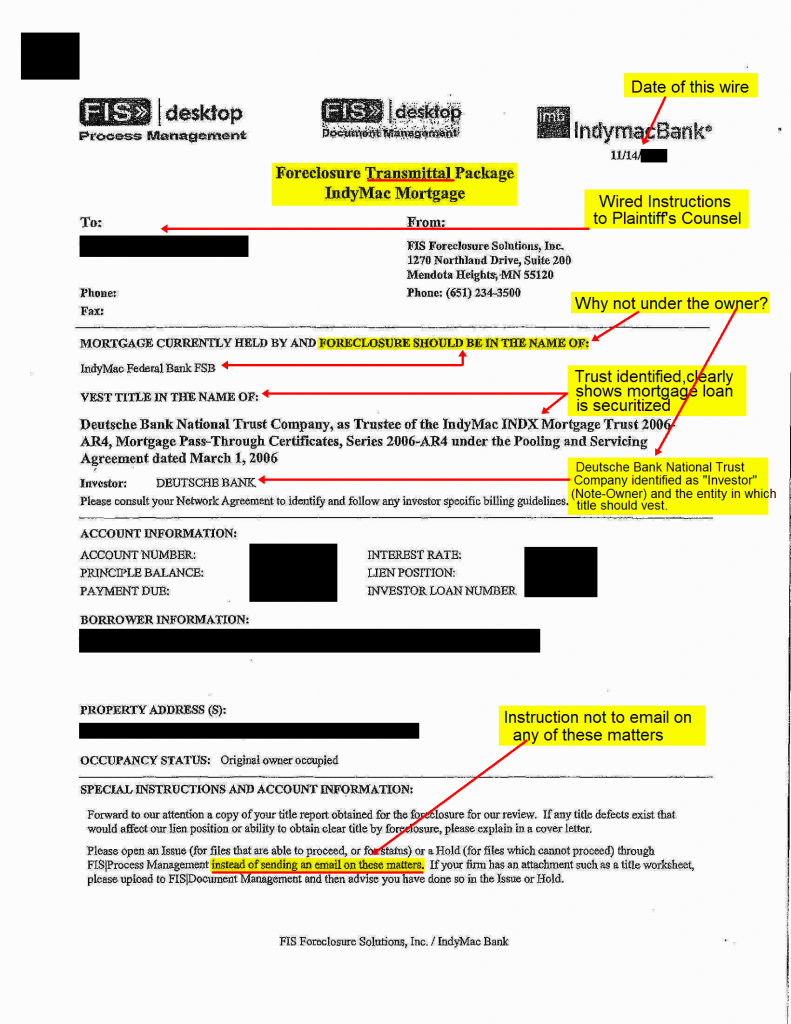
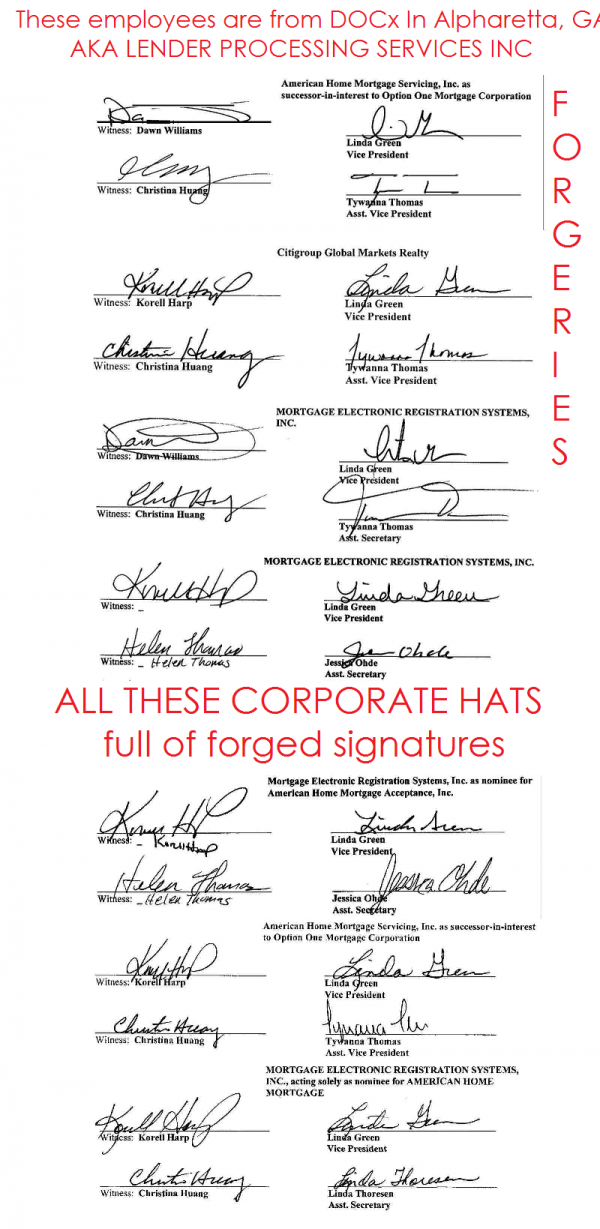
Below is a document that Lender Processing Services, Inc. or it’s many subsidiaries submits by wire transmission to the foreclosure mill with instructions NOT to name the actual owner of the note on the foreclosure but in the name of the servicer!
“FORECLOSURE SHOULD BE IN THE NAME OF ”
It clearly states the names of the real parties:
SERVICER
TRUST
TRUSTEE/NOTE-OWNER
BORROWER
A foreclosure is rarely commenced under the “Real Entity.” So why do they keep this from us when they knew all along the real parties of interest? This was only discovered during an actual case or we would have never found this.
Coakley begins probe, calls for foreclosure moratorium
By Herald Staff
Saturday, October 2, 2010 –
Massachusetts Attorney General Martha Coakley called on Bank of America and other major creditors to delay all foreclosure proceedings and pledged to begin her own investigation in light of recent revelations that they may not have complied with the law.
Bank of America announced Friday it was delaying foreclosures in 23 states, not including Massachusetts, as it examines whether it rushed the foreclosure process for thousands of homeowners without reading the documents.
“Our office has been extremely active in holding major banks and Wall Street firms accountable during this foreclosure crisis. We are concerned about the revelations that Bank of America and other major lenders have failed to properly review foreclosure documentation,” Coakley said yesterday in a statement. “Our office is now investigating this apparent failure of major creditors to follow state foreclosure law to ensure that Massachusetts homeowners are properly protected. In light of these revelations, we are asking Bank of America and other major creditors to cease foreclosure proceedings for Massachusetts homeowners until they can demonstrate that they have complied with Massachusetts law.”
Documents submitted to a court are supposed to be true as submitted. As an attorney, If I file a document with a court in which I swore I personally verified that the information contained within the document is true, and I didn’t actually do that, I’d get in real trouble. It’s simple: That’s fraud in the eyes of the court.
GMAC, JPMorgan Chase and Bank of America recently admitted that their employees routinely sign thousands of documents without verifying what they’re signing. Those documents are then submitted to courts as if the documents were true, to enable the banks to foreclose on delinquent properties. Wells Fargo and CitiMortgage told the New York Times their employees do not engage in similar practices. Yet new evidence shows they do.
Confusion at Wells Fargo
Herman John Kennerty of Wells Fargo has given a deposition describing the department he oversees for Wells Fargo. It’s a department dedicated to simply signing documents. Kennerty testified that he signs 50 to 150 documents a day, verifying only the date on each. What else might he want to verify? Well, in one document he signed, he supposedly transferred the mortgage from Washington Mutual Bank FA to Wells Fargo on July 12, 2010. But that’s impossible, since Washington Mutual Bank FA changed its name in 2004, and by any name WaMu ceased to exist in 2008, when the FDIC took it over. Making the document even less comprehensible, the debtor had declared bankruptcy a month earlier, according to Linda Tirelli, who represented the debtor. Why would Wells Fargo want a mortgage from someone in bankruptcy? Finally, Tirelli pointed out that the papers Wells Fargo filed included a different transfer of the mortgage dated three days before the debtor took out the loan. The documents are a mess, yet Kennerty signed them regardless. Legal Nonsense at CitiMortgage
Similarly, one M. Matthews signed a number of documents that CitiMortgage has used to try to foreclose on properties. While Matthews may or may not sign hundreds of documents a day — I have not yet found a deposition in which he swears that he does — he certainly does not verify the contents of the documents he’s signing. For example, he signed a document supposedly transferring a mortgage from Lehman Brothers to Citi in 2009. It’s hard to see how that’s possible, since Lehman had already ceased to exist. When confronted with its nonsensical filing, Citigroup decided not to foreclose. Instead, it gave the homeowner a meaningful mortgage modification–$15,000 principal reduction, plus a 30 year fixed mortgage at 3%. Tirelli, who represented the debtor in that case too, notes that she sees bad documents in the vast majority of cases, and she keeps files of “robosigned” documents.
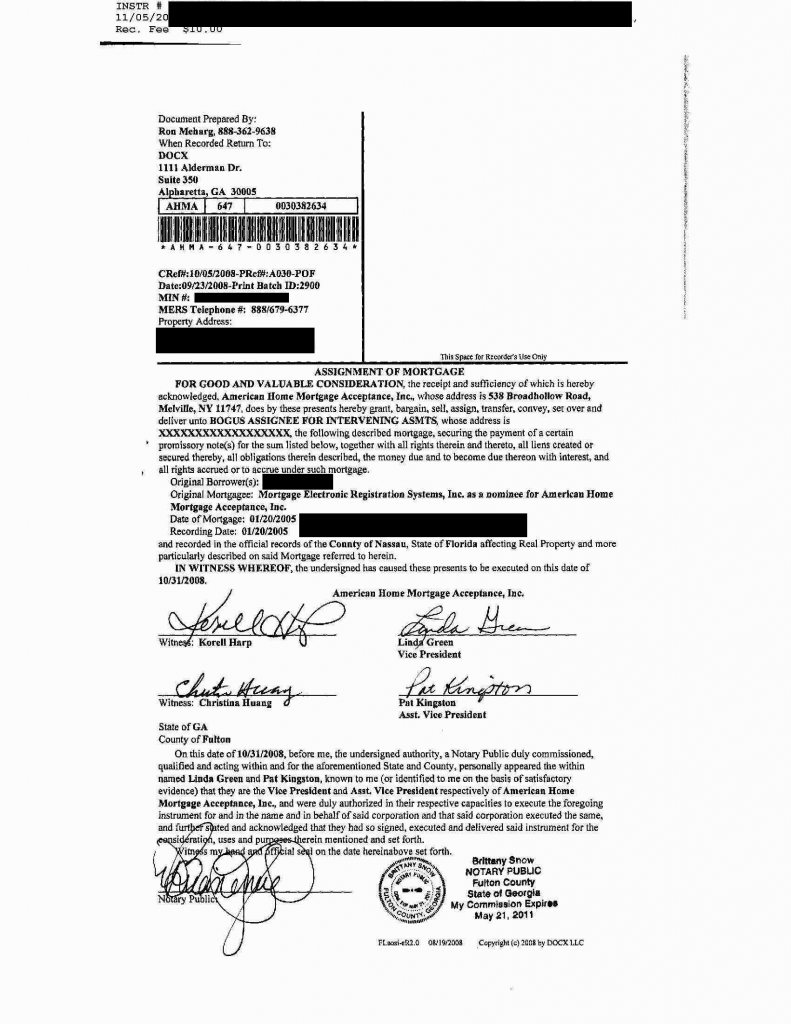
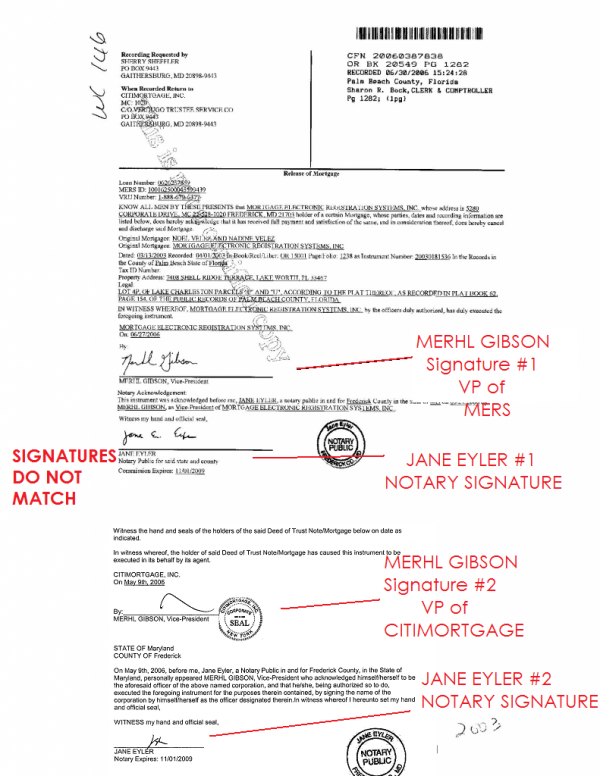
It’s true that in both the WaMu and Lehman Brothers documents, the signers were officially representing an entity called MERS and acting as the “nominee” of WaMu and the “nominee” of Lehman Brothers. But that doesn’t change the fraudulent nature of the documents as filed. MERS can’t continue to be the nominee of an entity that doesn’t exist. Moreover, MERS can’t assign something it doesn’t have, and MERS itself will admit it doesn’t own the underlying note or mortgage.
Possible Sanctions for JPMorgan Chase
Wells Fargo and CitiMortgage aren’t the only big banks to misrepresent their practices in the media; JPMorgan Chase told the New York Times that it had not withdrawn any documents in a pending case. However, Chase has in fact withdrawn robosigned documents in a case Tirelli is currently defending. Chase now faces possible sanctions in the case.
Why are the big, sophisticated banks submitting such problematic documents to the courts? The key reason is that sometimes when a bank wants to foreclose, it has to prove it actually has the right to foreclose — that it owns the note and accompanying mortgage. Unfortunately for the banks, the securitization of mortgages and the changes in property ownership documentation that accompanied it make it hard for the banks to establish clean chains of title and produce original documents. Hard, that is, in an environment where a massive number of foreclosures must be started and completed in a timely manner.
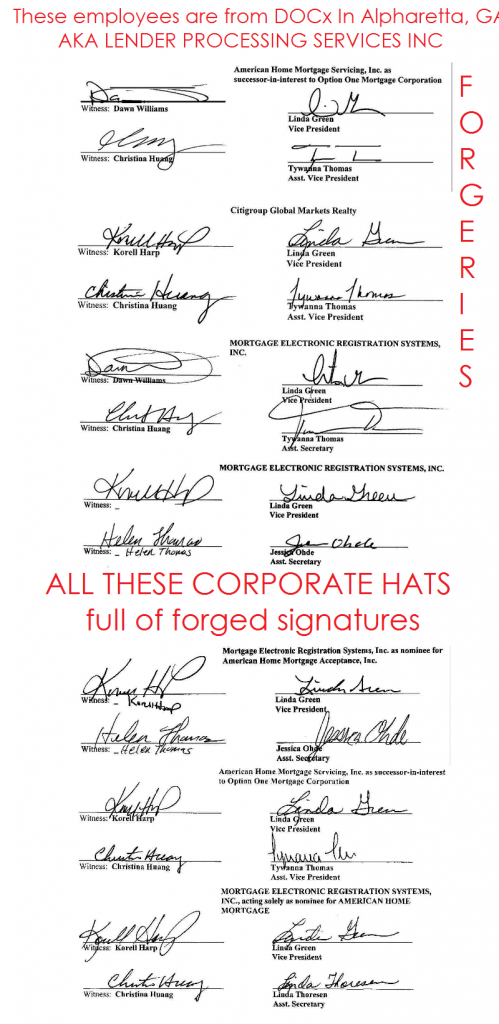
JOHN KENNERTY a/k/a Herman John Kennerty has been employed for many years in the Ft. Mill, SC offices of America’s Servicing Company, a division of Wells Fargo Bank, N.A. He signed many different job titles on mortgage-related documents, often using different titles on the same day. He often signs as an officer of MERS (“Mortgage Electronic Registration Systems, Inc.”) On many Mortgage Assignments signed by Kennerty, Wells Fargo, or the trust serviced by ASC, is shown as acquiring the mortgage weeks or even months AFTER the foreclosure action is filed.
Titles attributed to John Kennerty include the following:
Asst. Secretary, MERS, as Nominee for 1st Continental Mortgage Corp.;
Asst. Secretary, MERS, as Nominee for American Brokers Conduit;
Asst. Secretary, MERS, as Nominee for American Enterprise Bank of Florida;
Asst. Secretary, MERS, as Nominee for American Home Mortgage;
Asst. Secretary, MERS, as Nominee for Amnet Mortgage, Inc. d/b/a American Mortgage Network of Florida;
Asst. Secretary, MERS, as Nominee for Bayside Mortgage Services, Inc.;
Asst. Secretary, MERS, as Nominee for CT Mortgage, Inc.;
Asst. Secretary, MERS, as Nominee for First Magnus Financial Corporation, an Arizona Corp.;
Asst. Secretary, MERS, as Nominee for First National Bank of AZ;
Asst. Secretary, MERS, as Nominee for Fremont Investment & Loan;
Asst. Secretary, MERS, as Nominee for Group One Mortgage, Inc.;
Asst. Secretary, MERS, as Nominee for Guaranty Bank;
Asst. Secretary, MERS, as Nominee for Homebuyers Financial, LLC;
Asst. Secretary, MERS, as Nominee for IndyMac Bank, FSB, a Federally Chartered Savings Bank (in June 2010);
Asst. Secretary, MERS, as Nominee for Irwin Mortgage Corporation;
Asst. Secretary, MERS, as Nominee for Ivanhoe Financial, Inc., a Delaware Corp.;
Asst. Secretary, MERS, as Nominee for Mortgage Network, Inc.;
Asst. Secretary, MERS, as Nominee for Ohio Savings Bank;
Asst. Secretary, MERS, as Nominee for Paramount Financial, Inc.;
Asst. Secretary, MERS, as Nominee for Pinnacle Direct Funding Corp.;
Asst. Secretary, MERS, as Nominee for RBC Mortgage Company;
Asst. Secretary, MERS, as Nominee for Seacoast National Bank;
Asst. Secretary, MERS, as Nominee for Shelter Mortgage Company, LLC;
Asst. Secretary, MERS, as Nominee for Stuart Mortgage Corp.;
Asst. Secretary, MERS, as Nominee for Suntrust Mortgage;
Asst. Secretary, MERS, as Nominee for Transaland Financial Corp.;
Asst. Secretary, MERS, as Nominee for Universal American Mortgage Co., LLC;
Asst. Secretary, MERS, as Nominee for Wachovia Mortgage Corp.;
Vice President of Loan Documentation, Wells Fargo Bank, N.A.;
Vice President of Loan Documentation, Wells Fargo Bank, N.A., successor by merger to Wells Fargo Home Mortgage, Inc. f/k/a Norwest Mortgage, Inc.
The Associated Press
Friday, October 1, 2010; 4:28 PM
WASHINGTON — A Bank of America official acknowledges in a legal proceeding that she signed up to 8,000 foreclosure documents a month and typically didn’t read them.
The executive’s admission adds the nation’s largest bank to a growing list of mortgage companies whose employees signed documents in foreclosure cases without verifying the information in them.
Two other companies, Ally Financial Inc.’s GMAC Mortgage unit and JPMorgan Chase, have halted tens of thousands of foreclosure cases after similar problems became public.
The Bank of America executive said in a February deposition in a Massachusetts bankruptcy case that she signed 7,000 to 8,000 foreclosure documents a month.
“I typically don’t read them because of the volume that we sign,” the executive said.
The disclosure comes two days after JPMorgan said it would temporarily stop foreclosing on more than 50,000 homes so it can review documents that might contain errors. Last week, GMAC halted certain evictions and sales of foreclosed homes in 23 states to review those cases after finding procedural errors in some foreclosure affidavits.
After GMAC’s announcement, state attorneys general in California and Connecticut told the company to stop foreclosures until it proves it’s complying with their state laws. The Ohio attorney general this week asked judges to review GMAC foreclosure cases.
And in Florida, the state attorney general is investigating four law firms, two with ties to GMAC, for allegedly providing fraudulent documents in foreclosure cases.
In some states, lenders can foreclose quickly on delinquent mortgage borrowers. But 23 states use a lengthy court process for foreclosures. They require documents to verify information on the mortgage, including who owns it. Florida, New York, New Jersey and Illinois are the biggest states with this process.
By Ariana Eunjung Cha | October 1, 2010; 2:41 PM ET
Connecticut Attorney General Richard Blumenthal on Friday ordered a moratorium on all foreclosures by all banks for 60 days–the most radical action taken by a state on issue of document irregularities.
California also expanded the moratorium on foreclosures it announced last week on Ally Financial foreclosures to include those by J.P. Morgan Chase.
Calling the companies’ review of key foreclosure documents “a ruse,” California Attorney General Jerry Brown (D) ordered J.P. Morgan to prove it is following the law before it continues foreclosures in the state.
Both J.P. Morgan Chase and Ally have frozen foreclosures in 23 states because some employees had signed off on foreclosure paperwork without properly reviewing the files.
Colorado and Illinois have stopped foreclosures by Ally and at least seven other states have launched probes into the issue. But Connecticut is the first to institute an industry-wide ban.
The attorney general, Richard Blumenthal, also said he is investigating JPMorgan Chase & Co (JPM.N) over its foreclosure practices. He previously said he was investigating Ally Financial Inc and its GMAC Mortgage unit.
“Banks that lured consumers into loans they couldn’t afford now seek to stampede them into foreclosure,” Blumenthal said in a statement. “This freeze should stop a foreclosure steamroller based on defective documents and enable effective remedies.”
The decisions came after borrowers’ lawyers released affidavits suggesting that some lenders’ employees are submitting documentation in foreclosure proceedings without understanding the contents.
Investigators in at least six U.S. states are examining foreclosure practices at GMAC, JPMorgan or both, and calling for such practices to be defended or halted.
Blumenthal, a Democrat, is running for the U.S. Senate. (Reporting by Jonathan Stempel in New York; editing by John Wallace)
Continue to REUTERS
.
Press Release
Attorney General Asks CT Courts To Freeze Home Foreclosures 60 Days Because Of Defective Docs October 1, 2010
Attorney General Richard Blumenthal today asked the state Judicial Department to freeze all home foreclosures for 60 days because of defective document filings and institute measures to assure the integrity of future filings.
Blumenthal made the request after a second bank, JP Morgan Chase, acknowledged filing defective foreclosure documents. Like GMAC/Ally, JP Morgan admitted that so-called “robo-signers” signed affidavits without verifying the information in them. The GMAC robo-signer said under oath that he signed 8,000 to 10,000 foreclosure affidavits a month while a robo-signer for JP Morgan testified to spending less than two minutes on each affidavit.
Blumenthal is investigating GMAC/Ally and JP Morgan, as well as whether other banks may have engaged in similar practices.
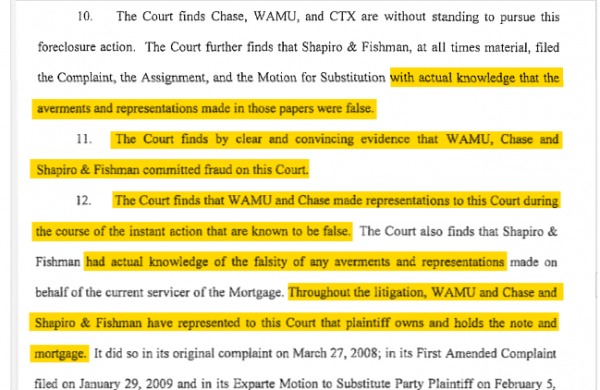
Submitting defective documents is a possible fraud upon the court, potentially undermining foreclosures and underlying mortgages.
“This freeze should stop a foreclosure steamroller based on defective documents and enable effective remedies,” Blumenthal said. “The actions of GMAC/Ally and JP Morgan are inexcusable, a possible fraud on the court undermining the integrity of the legal process and consumers’ ability to fight foreclosures. Banks that lured consumers into loans they couldn’t afford now seek to stampede them into foreclosure. We must stop this runaway foreclosure train, restoring proper procedure and property owner rights.
“The Judicial Department should take additional measures — including requiring signers to state the basis for verifying information in affidavits — to restore the integrity of foreclosure documents. This appalling practice must be stopped before it poisons the legal system and unfairly evicts families from their homes.”
SAN FRANCISCO (Reuters) – An outcry over questionable foreclosures by GMAC Mortgage and other lenders is likely to hit some states more than others because of major differences in real estate law across the nation.
But ramifications for federal taxpayers and investors will depend on the costs of clearing up the problem, the latest fallout from the bursting of the U.S. real estate bubble.
GMAC Mortgage announced last week that it had suspended evictions and post-foreclosure closings in 23 states due to concerns over paperwork. In order for a lender to foreclose on a property, it must prove that it actually checked the borrower’s loan agreements, and that the homeowner defaulted.
But the unit of Ally Financial, which is 56.3 percent owned by the U.S. government after a $17 billion bailout, said employees preparing foreclosures had submitted affidavits to judges containing information they did not personally verify.
“It’s a real mess,” said Justice Arthur Schack, a jurist on foreclosure issues who sits on the New York State Supreme Court in Brooklyn.
GMAC’s announcement has raised doubts about whether some people lost their homes without good reason. Attorneys general in several states, including California, Colorado, Illinois and Ohio, are investigating.
“The law demands that lenders prove their case in foreclosure actions,” Illinois Attorney General Lisa Madigan said last week.
But Ally characterizes the problem as merely technical, arguing that the underlying facts in each foreclosure are accurate.
“We are confident that the processing errors did not result in any inappropriate foreclosures,” it said in a statement last week.
GMAC landed in its predicament after one of its employees testified in a December 2009 deposition that he signed off on tens of thousands of affidavits containing information he did not verify.
The company said it has “substantially increased” the number of employees to verify documents, provided additional training, and suspended evictions out of an “abundance of caution.”
Ally isn’t the only firm under the microscope.
JPMorgan Chase & Co is delaying its current foreclosure proceedings and has begun to systematically re-examine related documents after discovering that some employees may have signed affidavits in some cases without personally reviewing the files.
Lawyers in Florida are questioning JPMorgan’s practices after discovering one of its executives did not check the details of its claims against a homeowner.
The executive said she had been part of an eight-person team that signs 18,000 documents a
Dear Judge XXXXX, I write you, and the other presiding and administrative judges of the Ohio Courts of Common Pleas, to draw your attention to an issue that may be of interest to you.
As you are aware, when a plaintiff in a foreclosure case moves for default or summary judgment, it will attach an affidavit from the lender or mortgage servicer attesting to the ownership and default status of loan. During the last week, questions have arisen about the validity of the foreclosure affidavits filed by a large servicer, GMAC Mortgage. GMAC (also operating as “Ally Financial”) issued a press release on September 20, 2010 announcing that it had directed certain of its vendors to suspend evictions and REO closings because of “a potential issue that was raised in a number of existing foreclosures challenging the internal procedure we used for executing one or more judicially required forms.”
A number of media outlets, including The Washington Post and The New York Times, reported on this statement. The news articles suggest that GMAC’s actions are related to a Florida deposition and a Maine deposition given by one of its employees, Jeffrey Stephan. Mr. Stephan signed thousands of foreclosure affidavits for GMAC, but in his depositions stated that he does not have knowledge of how the information in the affidavit is determined (Deposition of Jeffrey Stephan, June 7, 2010, p 30), does not know how the accuracy of the information is verified (Id.), does not review the exhibits attached to the affidavit (Id., p 54), does not read every paragraph of the affidavit (Id. p 61), and does not have the affidavit notarized in his presence (Id., p 56).
The depositions were not taken by my office, so I do not opine on their accuracy, but I wanted to draw your attention to this issue. At least one court has found that filing affidavits that falsely claim personal knowledge is a violation of the Ohio Consumer Sales Practices Act when filed in connection with consumer transactions. Midland Funding, LLC v. Brent, 644 F. Supp. 2d 961, 977 (N.D. Ohio, 2009).
More broadly, I urge you as administrators to share this letter with your colleagues and urge them to exercise caution when approving any foreclosure orders involving GMAC. Further, I encourage you to consider whether additional administrative procedures need to be established to protect homeowners who are facing the threat of foreclosure. Issues similar to those surrounding GMAC have arisen in Ohio. For example, my office filed an amicus brief in an appellate case where a foreclosure affidavit averred that it was executed in Florida but the jurat and notarization stated that it was executed in New Jersey. The 2nd District Court of Appeals ruled that the trial court did not abuse its discretion by striking the faulty affidavit. HSBC Bank USA v. Thompson, 2010-Ohio-4158.
Please feel free to contact me or my Consumer Protection Section Chief, Susan Choe, at 614.466.1305, if we can be of any assistance regarding this letter.
Thank you.
Sincerely,
Richard Cordray
Ohio Attorney General
CC:
Sarah Lynn, Deputy Chief Counsel, Ohio Attorney General
Susan Choe, Consumer Protection Section Chief, Ohio Attorney General
Chase Home Finance, LLC
Whitney Cook
Beth Cottrell
Margaret Dalton
JPMorgan Chase
Lender Processing Services
Long Beach Mortgage
Stacy Spohn
Christina Trowbridge
Washington Mutual Bank
Action Date: September 30, 2010
Location: New York, NY
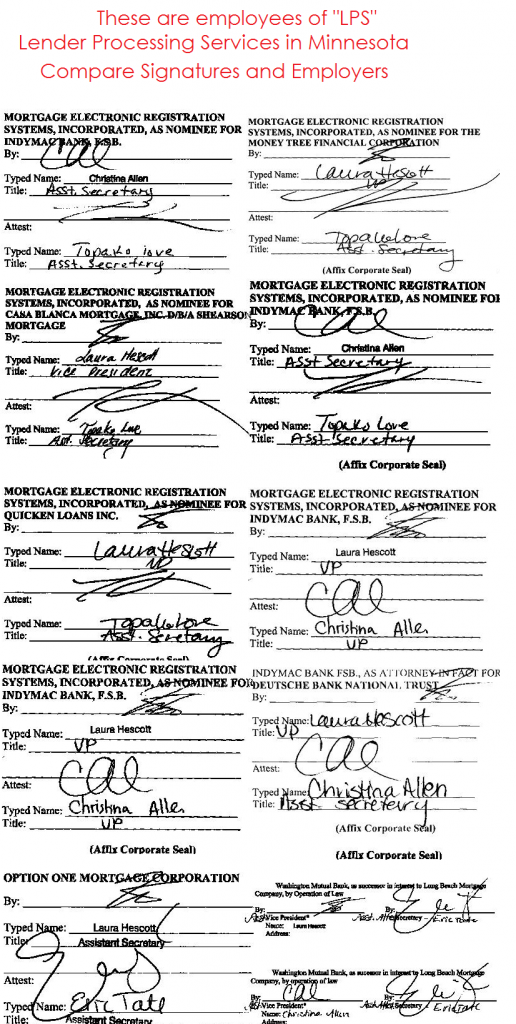
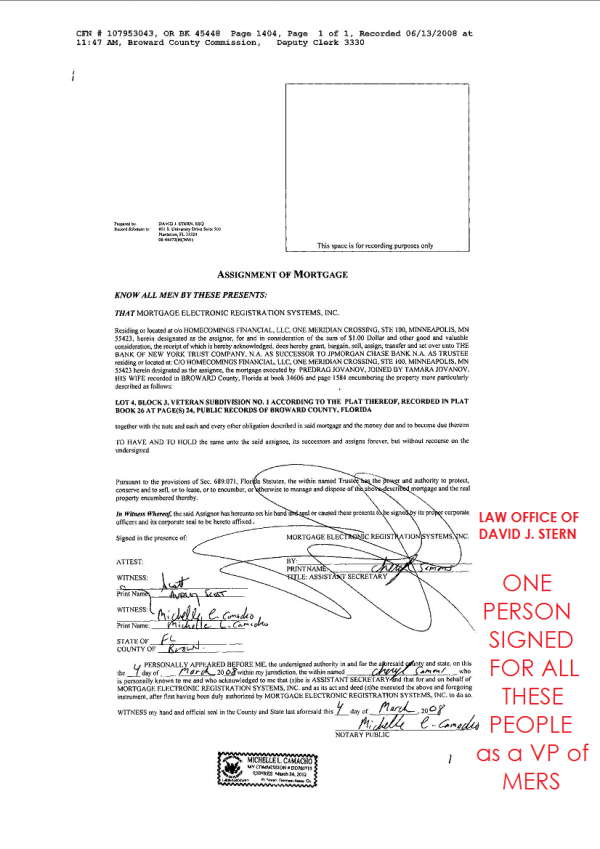
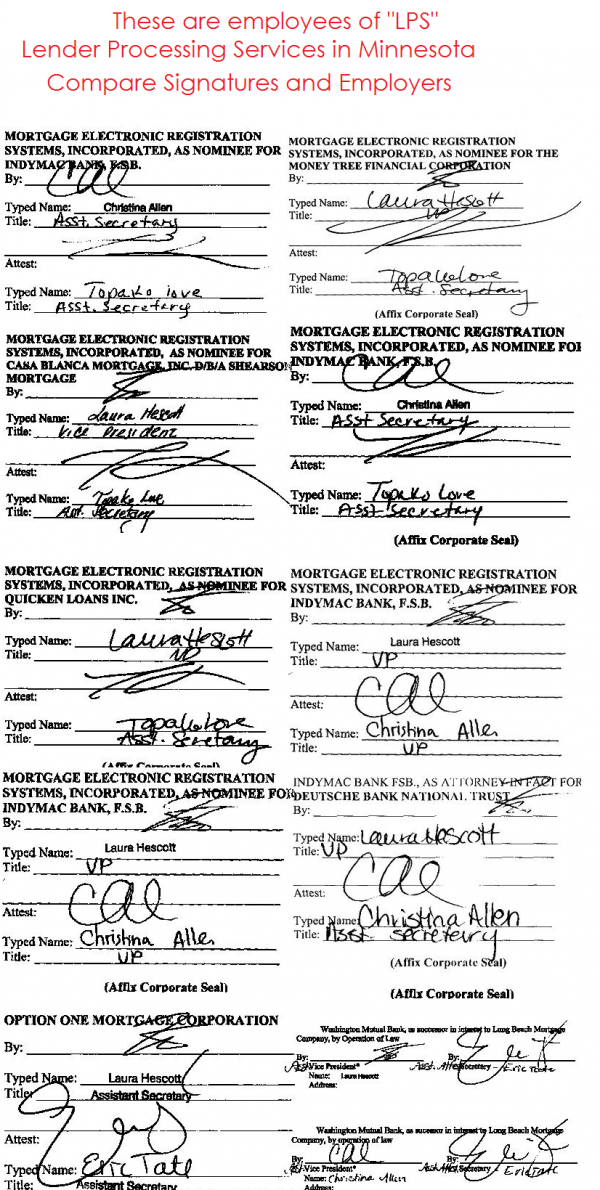
On September 29, 2010, financial giant JP Morgan Chase announced it was suspending 56,000 foreclosures because its documents may have been “submitted without proper review.” To assist JPMorgan Chase, Fraud Digest suggests that it dismiss those actions where the Affidavits or Mortgage Assignments were signed by the following robo-signers: Beth Cottrell, Whitney Cook, Christina Trowbridge and Stacy Spohn from the Chase Home Finance office in Franklin County, OH; Margaret Dalton and Barbara Hindman from the Jacksonville, FL office of JPMorgan Chase; and any of the Lender Processing Services robo-signers from the Dakota County, MN office including Christina Allen, Liquenda Allotey, Christine Anderson, Alfonzo Greene, Laura Hescott, Bethany Hood, Cecelia Knox, Topako Love, Jodi Sobotta, Eric Tate, Amy Weis and Rick Wilken. In particular, JP Morgan Chase should look at those cases where the bank has supposedly assigned mortgages to WaMu, WMALT, Long Beach Mortgage Company and NovaStar trusts years after the closing dates of these trusts. The number of questionable or fraudulent documents is likely to be much closer to 560,000 than to 56,000, and that will only be a good beginning.
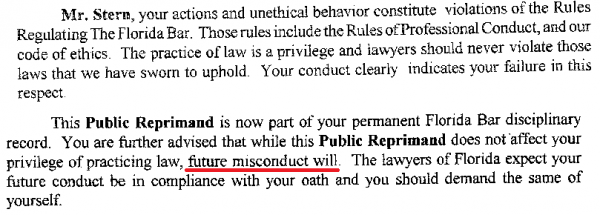
It was a very sad day for Floridians yesterday when the Florida Supreme Court issued a statement that it does not have authority to intercede while a fraud investigation is pending. Although we may not agree with the decision, we must respect procedures that must be followed.
Florida, do not quit what you are doing because there are many states that we must continue to focus on. Judges need to put themselves in the homeowners situation and understand we cannot make these fraudulent documents up. These documents are sworn statements, under perjury of law and notarized. As officers of the court they must be held accountable. No ifs, ands, buts or suppose here. These are not errors.
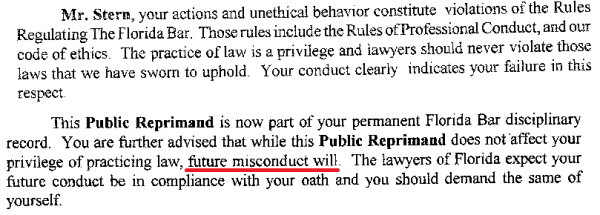
Rest assured that The Florida Bar still has many pending investigations with these foreclosure firms and they have authority overseeing the misconduct of their members.
I am your voice, America. I share your fears, read your concerns and do try my best to reach out to you.
The Florida Constitution and court rules did not give the Chief Justice authority to intercede in pending cases involving attorney misconduct, or to investigate allegations of fraud or misconduct in foreclosure cases. The fraud cases must first beadjudicated in trial courts.
Congressman Grayson has asked the Florida Bar to take action.
Florida Default Law Group has been added as the fourth law firm under investigation along the Law offices of David J. Stern, Shapiro & Fishman and Law Office of Marshall Watson.
See where Judge Schack takes this and even if not mentioned he makes reference to MERS. Every judge must follow his example and read and research each case because it the end “each case is unique”.If we can only make a rubber stamp weigh 2 tons?? Hmm
By GREGORY BRESIGER Last Updated: 1:29 AM, September 26, 2010 Posted: 1:07 AM, September 26, 2010
With foreclosure filings growing by the month, some judges are holding banks and loan servicers’ feet to the fire to prove they “own” the mortgage and that they know what information is in the filing.
Recently, JPMorgan Chase, a mortgage servicer, was charged by a Florida judge with submitting fraudulent foreclosure paperwork on a home it did not own.
Ally Bank, formerly GMAC, the credit arm of the troubled automaker General Motors, suspended foreclosure proceedings in 23 states including New York last week, while it reviews its foreclosure procedures.
Ally, which has a $349.1 billion mortgage portfolio, according to industry records, and was also the beneficiary of more than $17 billion in US bailout funds, said this week it has amended its foreclosure procedure to make sure the documents contain truthful information and that there is a notary present when documents are signed.
Closer to home, in New York State Supreme Court no foreclosure hearing is routine in Judge Arthur Schack’s courtroom in Brooklyn. That’s where dozens of bank attorneys are learning that every detail must be right or else.
Judge Schack — the scourge of numerous banks and poorly prepared attorneys — has thrown out dozens of foreclosure applications for just the same reasons cited in Florida.
Judge Schack examines every filing in detail. That’s because “every case is unique,” said the 64-year-old judge, a former high-school social-studies teacher.
Why the large number of foreclosure dismissals for a procedure that is often routinely granted?
Ally’s GMAC unit withdraws foreclosure affidavits signed by second employee
By Ariana Eunjung Cha | September 25, 2010; 11:34 AM ET
Was Kristine Wilson another “robo-signer”?
Attorneys for homeowners in Florida say Ally Financial’s GMAC mortgage unit has begun to withdraw affidavits submitted in support of foreclosures that were signed by a second employee. Like Jeffrey Stephan–the document processor who admitted in sworn testimony that he signed 10,000 documents a month without reviewing them–Kristine Wilson signed as a “limited signing officer” for GMAC.
In a request to withdraw an affidavit listing debts owed by a homeowner that was signed by Wilson in a Palm Beach County Circuit Court case, lawyers for GMAC say that “information in the affidavit may not have been properly verified.”
Sept. 25 (Bloomberg) — Attorneys general in three U.S. states are investigating foreclosures at Ally Financial Inc.’s GMAC Mortgage unit after the lender said it would halt some evictions following a discovery of faulty documentation.
Texas, Iowa and Illinois have started investigations into mortgage practices at Ally, while California, which isn’t affected by GMAC’s action, ordered the company to stop foreclosures unless it can prove compliance with state law, according to statements. Ally said it has issued a “more robust policy” on processing foreclosures, increased staff to handle documents and instituted more training for employees.
“Preserving the integrity of the foreclosure process is of the utmost importance,” Ally said yesterday in a statement. “While we are exercising an abundance of caution in the review process, we are confident that the processing errors did not result in any inappropriate foreclosures.”
Continue reading…BUSINESS WEEK
.
September 24, 2010
ATTORNEY GENERAL MADIGAN DEMANDS MEETING WITH
MORTGAGE LENDER AT CENTER OF FORECLOSURE CONTROVERSY
GMAC Suspected of Submitting False Documents in Foreclosure Cases
Chicago Attorney General Lisa Madigan today issued a letter to the mortgage lender Ally (formerly GMAC) demanding a meeting to address concerns that the company has violated the state’s Consumer Fraud Act in its pursuit of Illinois homeowners in foreclosure. Madigan’s letter responds to reports raising serious questions about the accuracy of documents the lender files in foreclosure lawsuits.
An Ally employee testified in a Florida court case that he routinely signed affidavits for foreclosure lawsuits and submitted them to Ally’s attorneys without reviewing the homeowners’ loan documents. These affidavits were then filed with the court as evidence of Ally’s right to foreclose on the homes. The employee testified that he signed at least 10,000 affidavits a month without reviewing the underlying paperwork, and thus had no way of knowing whether the information in the affidavits was actually true.
“Families’ homes are at stake here,” Madigan said. “If I determine that Ally is rubber-stamping affidavits and filing them with our courts as evidence, I will take appropriate action. The law demands that lenders prove their case in foreclosure actions, and Illinois homeowners demand the same.”
Following these revelations, Ally announced this week that it is suspending foreclosure lawsuits in 23 states, including Illinois.
Madigan also requested that Ally immediately provide her office with details on the impact of Ally’s conduct on Illinois homeowners, including the number of Illinois homeowners affected by the suspension of foreclosures; the names of the Illinois law firms that Ally retains to pursue foreclosure actions; information about how these firms will implement and monitor the suspension of foreclosure lawsuits in Illinois; and the length of the suspension.
GMAC ranked fourth among U.S. home mortgage lenders in the first six months of this year, according to Inside Mortgage Finance, an industry newsletter.
THIS IS HUGE! Coming in… Florida might halt all Foreclosures…While pending investigation of MILLS!
SUPREME COURT,
Do what is right and protect these families. This involves children that do not understand what is going on. I lost my home to this fraud and they do not have to go through my stressful experience. You set new rules and these foreclosure mills continued to ignore you. What is it going to take?
I revere the law, the judicial system, and the legal profession and will at all times in my professional
and private lives uphold the dignity and esteem of each.
I will further my profession’s devotion to public service and to the public good.
I will strictly adhere to the spirit as well as the letter of my profession’s code of ethics, to the extent
that the law permits and will at all times be guided by a fundamental sense of honor, integrity, and fair
play. I will not knowingly misstate, distort, or improperly exaggerate any fact or opinion and will not
improperly permit my silence or inaction to mislead anyone.
I will conduct myself to assure the just, speedy and inexpensive determination of every action and
resolution of every controversy.
I will abstain from all rude, disruptive, disrespectful, and abusive behavior and will at all times act
with dignity, decency, and courtesy.
I will respect the time and commitments of others.
I will be diligent and punctual in communicating with others and in fulfilling commitments. I will exercise independent judgment and will not be governed by a client’s ill will or deceit.
My word is my bond.
Oath of Admission to The Florida Bar
The general principles which should ever control the lawyer in the practice of the legal profession
are clearly set forth in the following oath of admission to the Bar, which the lawyer is sworn on
admission to obey and for the willful violation to which disbarment may be had.
“I do solemnly swear:
“I will support the Constitution of the United States and the Constitution of the State of Florida;
“I will maintain the respect due to courts of justice and judicial officers;
“I will not counsel or maintain any suit or proceedings which shall appear to me to be unjust, nor
any defense except such as I believe to be honestly debatable under the law of the land;
“I will employ for the purpose of maintaining the causes confided to me such means only as are
consistent with truth and honor, and will never seek to mislead the judge or jury by any artifice or false
statement of fact or law;
“I will maintain the confidence and preserve inviolate the secrets of my clients, and will accept no
compensation in connection with their business except from them or with their knowledge and approval;
“I will abstain from all offensive personality and advance no fact prejudicial to the honor or reputation
of a party or witness, unless required by the justice of the cause with which I am charged;
“I will never reject, from any consideration personal to myself, the cause of the defenseless or
oppressed, or delay anyone’s cause for lucre or malice. So help me God.”
California officials today demanded that Ally Financial Inc. stop foreclosing on homes in the state, citing reports indicating the big mortgage lender is violating the law.
The cease-and-desist letter, issued by Attorney General Jerry Brown, came as officials in several other states began investigating Ally’s operations.
The controversy stems from a Florida court case in which an Ally official reportedly testified that he signed thousands of documents in foreclosure cases without even reviewing the homeowners’ loan documents.
This should send a powerful message to each and every Foreclosure Mill out there! You are NEXT!
September 24, 2010
Michael J. Williams
President and Chief Executive Officer
Fannie Mae
3900 Wisconsin Avenue, N.W.
Washington, D.C. 20016
Dear Mr. Williams,
We are disturbed by the increasing reports of predatory ‘foreclosure mills’ in Florida working for Fannie Mae servicers. Foreclosure mills are law firms representing lenders that specialize in speeding up the foreclosure process, often without regard to process, substance, or legal propriety. According to the New York Times, four of these mills are both among the busiest of the firms and are under investigation by the Attorney General of Florida for fraud. The firms have been accused of fabricating or backdating documents, as well as lying to conceal the true owner of a note.
Several of the busiest of these mills show up as members of Fannie Mae’s Retained Attorney Network, a set of legal contractors on whom Fannie relies to represent its interests as a note-holder. The network also serves as a pool of legal talent that represents Fannie in its pre-filing mediation program, a program designed to facilitate communication between borrowers and servicers prior to foreclosure. In other words, Fannie Mae seems to specifically delegate its foreclosure avoidance obligations out to lawyers who specialize in kicking people out of their homes.
The legal pressure to foreclose at all costs is leading to a situation where servicers are foreclosing on properties on which they do not even own the note. This practice is blessed by a legal system overwhelmed with foreclosure cases and unable to sort out murky legal details, and a set of law firms who mass produce filings to move foreclosures as quickly as possible. At the very least, we would encourage you to remove foreclosure mills under investigation for document fraud from the Fannie Mae’s Retained Attorney Network. We also believe that Fannie should have guidelines allowing servicers to proceed on a foreclosure only when its legal entitlement to foreclose is clearly documented. In addition, these charges raise a number of questions for us about the foreclosure process as it pertains to Fannie Mae’s holdings.
Why is Fannie Mae using lawyers that are accused of regularly engaging in fraud to kick people out of their homes? Given that Fannie Mae is at this point a government entity, and it is the policy of the government that foreclosures are a costly situation best avoided if there are any lower cost alternatives, what steps is Fannie Mae taking to avoid the use of foreclosure mills? What additional steps is Fannie Mae going to take to ensure that foreclosures are done only when necessary and only in accordance with recognized law? How do your servicer guidelines take into account the incentives for fraud in the fee structure of foreclosure attorneys and others engage in the foreclosure process? What mechanisms do you employ to monitor legal outsourcing?
We look forward to your responses and to understanding more about these disturbing dynamics in future hearings.










 See full article from DailyFinance: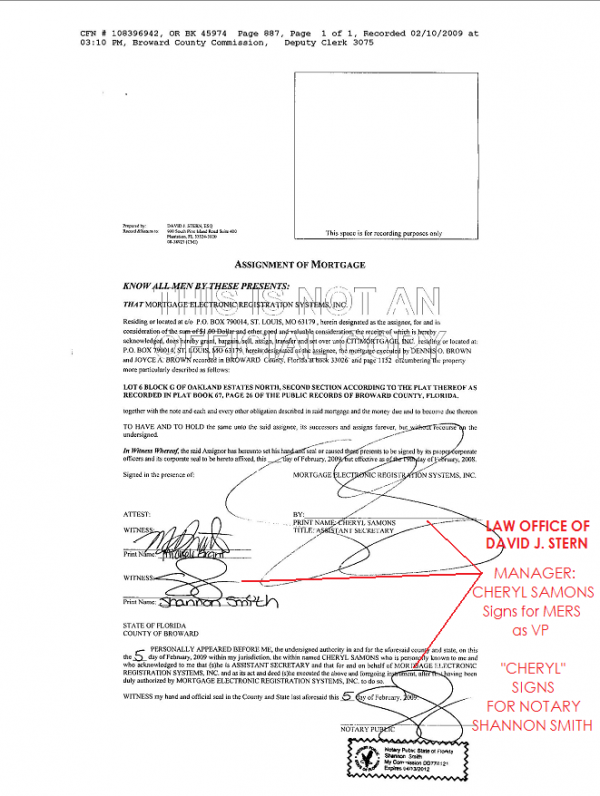



 Washington Post























Recent Comments