California Democratic Congressional Delegation Urges Bank Investigations
October 5, 2010
Washington, D.C. – Today, California Democratic Congressional Delegation (CDCD) members sent a letter to Attorney General Holder, Federal Reserve Chair Bernanke, and Comptroller of the Currency Walsh requesting investigations into systemic wrongdoing by financial institutions in their handling of delinquent mortgages, mortgage modifications, and foreclosures. Delegation members have received thousands of complaints from their constituents, which appear to outline a clear pattern of misconduct on the part of lenders and servicers. Recent press accounts have also reinforced the view that these institutions are routinely failing to respond in a timely manner, misplacing requested documents, and misleading both borrowers and the government about loan modifications, forbearances, and other housing related applications.
“It’s clear that even after promising to work with borrowers, and receiving government incentives to do so, financial institutions are simply stringing the American people along,” noted Delegation Chair, Rep. Zoe Lofgren. “After reviewing thousands of complaints from our constituents, it appears that we aren’t dealing with isolated incidents and that a pattern of misconduct and obstruction is present.”
Dear Attorney General Holder, Chairman Bernanke and Comptroller Dugan, As members of the California Democratic Congressional Delegation, we urge you and your respective agencies to investigate possible violations of law or regulations by financial institutions in their handling of delinquent mortgages, mortgage modifications, and foreclosures.
Over the last few years, thousands of our constituents have reported that many financial institutions, despite good faith efforts on the part of most homeowners to work out reasonable loan modifications or simply seek forbearance of foreclosure, routinely fail to respond in a timely manner, misplace requested documents, and send mixed signals about the requirements that need to be met to avoid foreclosures. We are particularly perplexed by this apparent pattern in light of the many incentives Congress and the Obama Administration have offered to servicers and lenders to avoid foreclosures where financially viable, including subsidies and loan guarantees from taxpayers. Avoidable foreclosures end up being unnecessarily costly for homeowners, lenders and servicers, and our housing market, whose health is essential to our economic recovery.
The apparent pattern reported by our constituents leads us to conclude that their problems are not just personal anecdotes anymore. Recent reports that Ally Financial (formerly GMAC) and JP Morgan may have approved thousands of unwarranted foreclosures only amplify our concerns that systemic problems exist in the ways many financial institutions have dealt with homeowners who are seeking to avoid foreclosures.
who are seeking to avoid foreclosures. We are now in the third year of the worst housing crisis we have seen in decades. Far too many families in California, and across the country, continue to lose their homes. While Congress and the Obama Administration have taken steps to help mitigate the housing problem, this devastation has persisted and, in fact, worsened as the country’s unemployment rate increased. We have heard numerous stories of financial institutions being uncooperative at best or misleading and acting in bad faith at worst. These heartbreaking stories are commonplace, persisting across the state and across lenders and servicers. As you can see from the attached document, which highlights examples of casework throughout California, it appears that banks have repeatedly misled and obstructed homeowners from receiving the help Congress and the Administration have sought to provide.
The excuses we have heard from financial institutions are simply not credible three years into this crisis. People in our districts are hurting. We have tried to help them in the face of the many challenges they have faced in their dealings with financial institutions. It is time that banks are held accountable for their practices that have left too many homeowners without real help.
Sincerely,
Zoe Lofgren
The California Democratic Congressional Delegation consists of 34 Democratic members of the U.S. House of Representatives from California. This group outnumbers all other state House delegations – Republicans and Democrats combined.
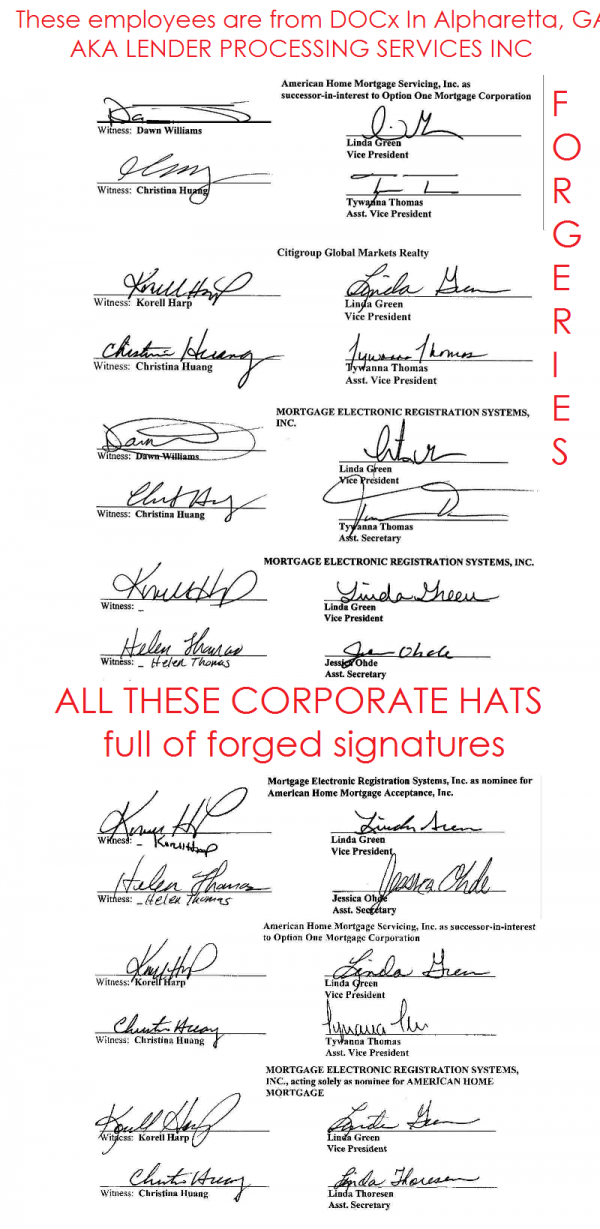
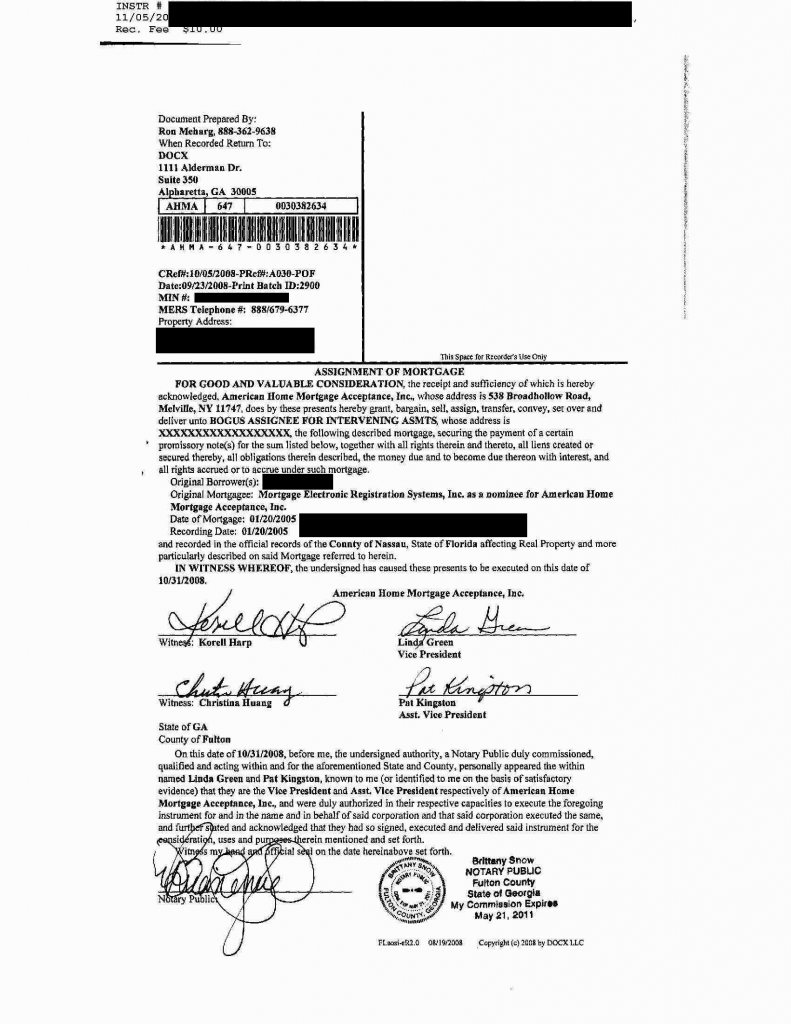
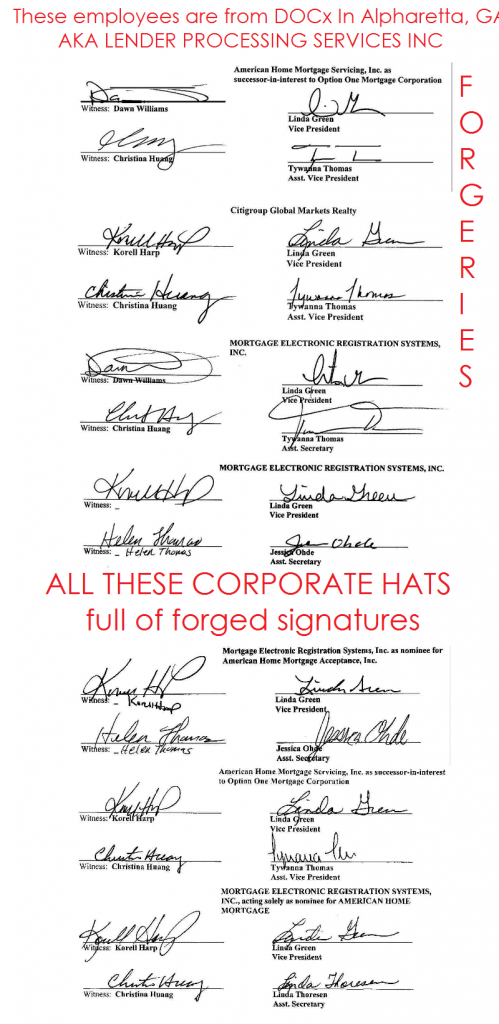
Congratulations… Tywanna Thomas makes Good Morning America. Tywanna Thomas is/was an employee of Lender Processing Services/ DOCX and these documents were executed in DOCX’s office in Alpharetta, GA.
You may see her many signatures and employers below. “It’s not just her”
“If your going to take my house away from me you better be able to prove you own my house and you have the right to take the house away” -GERRY WILLIS
______
Link to the source: ABCNEWS.com
.
http://abcnews.go.com/GMA/YourMoney/video/banks-freeze-faulty-foreclosures-11792395
In addition to renewing it’s Motion for Summary Judgment, Plaintiff has also filed a Motion for Entry of Protective Order pursuant to M.R. Civ. P. 26 (c). This motion is likewise denied.
Rule 26(c) provides that “for good cause shown” a court may enter a protective order “which justice requires to protect a party or person from annoyance, embarrassment, oppression, or undue burden or expense….” M.R.Civ. P. 26(c). Plaintiff seeks a protective order prohibiting the dissemination of discovery materials obtained in this case.” Plaintiff’s Motion for Entry of Protective Order at 7. As grounds for it’s motion, Plaintiff points to the embarrassment GMAC and it’s employees have suffered, and will continue to suffer, from the posting of excerpts from Stephan’s deposition transcript on an Internet blog. The court is not persuaded that the Plaintiff has shown the requisite “ good cause” to justify entry of a protective order in this case. See e.g. Public Citizen v. Liggett Group, Inc., 858 F.2d 775, 789 (1st Cir. 1988) (agreeing with Second Circuit in noting that “the party seeking a protective order has burden of showing that good cause is not shown, the discovery materials in question should not receive judicial protection and therefore would be open to the public for inspection”) (citation omitted).
Stephan’s deposition was taken in advance a legitimate purpose, and the testimony elicited has directed probative value to dispute. Attorney Cox did not himself take action other that to share the deposition transcript with an attorney in Florida. That the testimony reveals corporate practices that GMAC finds embarrassing in not enough to justify issuance of a protective order. Further, Plaintiff has failed to establish that GMAC has been harmed specifically as a result of the dissemination of the June 7, 2010 deposition transcript, given that similarly embarrassing deposition from December 10, 2009 Florida deposition also appears on the Internet, and will remain even were this Court to grant Plaintiff’s motion. Accordingly, because Plaintiff has failed to satisfy it’s burden of persuasion under Rule 26(c), it’s Motion for Entry of Protective Order is denied.
Please send me any Corporate Resolutions or Signing Agreements you may have. These were provided mainly to Vendors/ Foreclosure Mills. Not easy to get but also not impossible.
Be it Resolved that the attached list of candidates are employees of (Insert Name of MERS Member), a Member of Mortgage Electronic Registration Systems, Inc. (MERS), and are hereby appointed as assistant secretaries and vice presidents of MERS, and, as such, are authorized to:
(1) Release the lien of any mortgage loan registered on the MERS® System that is shown to be registered to the Member;
(2) Assign the lien of any mortgage loan naming MERS as the mortgagee when the Member is also the current promissory note-holder, or if the mortgage loan is registered on the MERS® System, is shown to be registered to the Member;
(3) Execute any and all documents necessary to foreclose upon the property securing any mortgage loan registered on the MERS® System that is shown to be registered to the Member, including but not limited to (a) substitution of trustee on Deeds of Trust, (b) Trustee’s Deeds upon sale on behalf of MERS, (c) Affidavits of Non-military Status, (d) Affidavits of Judgment, (e) Affidavits of Debt, (f) quitclaim deeds, (g) Affidavits
regarding lost promissory notes, and (h) endorsements of promissory notes to VA or HUD on behalf of MERS as a required part of the claims process;
(4) Take any and all actions and execute all documents necessary to protect the interest of the Member, the beneficial owner of such mortgage loan, or MERS in any bankruptcy proceeding regarding a loan registered on the MERS® System that is shown to be registered to the Member, including but not limited to: (a) executing Proofs of Claim and Affidavits of Movant under 11 U.S.C. Sec. 501-502, Bankruptcy Rule 3001-3003, and applicable local bankruptcy rules, (b) entering a Notice of Appearance, (c) vote for a trustee of the estate of the debtor, (d) vote for a committee of creditors, (e) attend the meeting of creditors of the debtor, or any adjournment thereof, and vote on behalf of the Member, the beneficial owner of such mortgage loan, or MERS, on any question that may be lawfully submitted before creditors in such a meeting, (f) complete, execute, and return a ballot accepting or rejecting a plan, and (g) execute reaffirmation agreements;
(5) Take any and all actions and execute all documents necessary to refinance, subordinate, amend or modify any mortgage loan registered on the MERS® System that is shown to be registered to the Member.
(6) Endorse checks made payable to Mortgage Electronic Registration Systems, Inc. to the Member that are received by the Member for payment on any mortgage loan registered on the MERS® System that is shown to be registered to the Member;
(7) Take any such actions and execute such documents as may be necessary to fulfill the Member’s servicing obligations to the beneficial owner of such mortgage loan (including mortgage loans that are removed from the MERS® System as a result of the transfer thereof to a non-member of MERS).
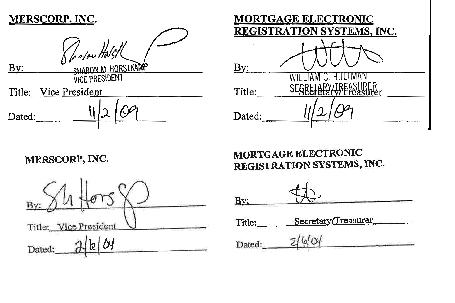
I, William C. Hultman, being the Corporate Secretary of Mortgage Electronic Registration Systems, Inc., hereby certify that the foregoing is a true copy of a Resolution duly adopted by the Board of Directors of said corporation effective as of the day of , which is in full force and effect on this date and does not conflict with the Certificate of Incorporation or By-Laws of said corporation.
____________________________________
William C. Hultman, Secretary
Excellent resource on MERS below from the law department:
Gretchen Morgenson is a Pulitzer Prize winning journalist.Gretchen is one of the first journalist who began reporting on the mortgage crisis and understands exactly what is happening all around us. We thank Gretchen for all her hard work and we are proud to say she is aware of StopForeclosureFraud.com 🙂
Gretchen Morgenson, Pulitzer Prize winning New York Times writer, interviewed for Pacific Street’s upcoming feature doc on the financial crisis. Begun in 2007, this film (yet untitled) has strayed in many directions; covered much ground, and, when completed, will offer a very different perspective on the personalities and companies that have played the principal leads in the longest-running soap opera in this country’s financial history. A Ken Burns documentary it is not…
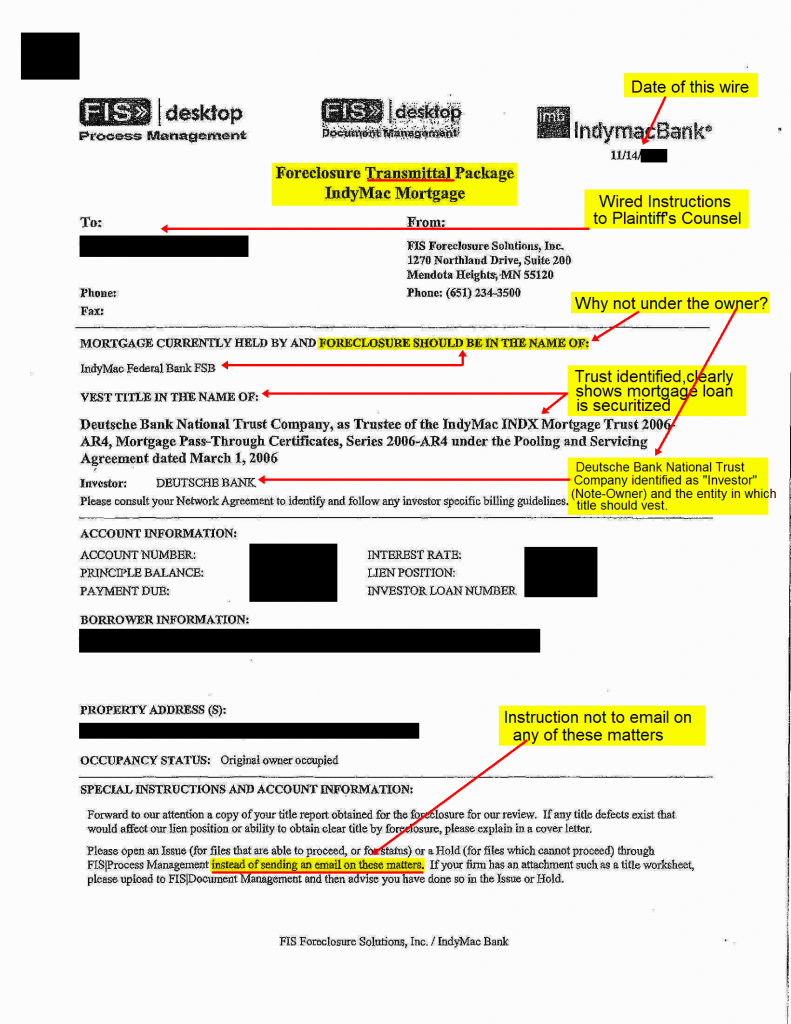
Below is a document that Lender Processing Services, Inc. or it’s many subsidiaries submits by wire transmission to the foreclosure mill with instructions NOT to name the actual owner of the note on the foreclosure but in the name of the servicer!
“FORECLOSURE SHOULD BE IN THE NAME OF ”
It clearly states the names of the real parties:
SERVICER
TRUST
TRUSTEE/NOTE-OWNER
BORROWER
A foreclosure is rarely commenced under the “Real Entity.” So why do they keep this from us when they knew all along the real parties of interest? This was only discovered during an actual case or we would have never found this.
Coakley begins probe, calls for foreclosure moratorium
By Herald Staff
Saturday, October 2, 2010 –
Massachusetts Attorney General Martha Coakley called on Bank of America and other major creditors to delay all foreclosure proceedings and pledged to begin her own investigation in light of recent revelations that they may not have complied with the law.
Bank of America announced Friday it was delaying foreclosures in 23 states, not including Massachusetts, as it examines whether it rushed the foreclosure process for thousands of homeowners without reading the documents.
“Our office has been extremely active in holding major banks and Wall Street firms accountable during this foreclosure crisis. We are concerned about the revelations that Bank of America and other major lenders have failed to properly review foreclosure documentation,” Coakley said yesterday in a statement. “Our office is now investigating this apparent failure of major creditors to follow state foreclosure law to ensure that Massachusetts homeowners are properly protected. In light of these revelations, we are asking Bank of America and other major creditors to cease foreclosure proceedings for Massachusetts homeowners until they can demonstrate that they have complied with Massachusetts law.”
“They have no personal knowledge of the issue and they are supposed to. That is what these judges rely on when they issue judgments against homeowners,” said Matt Englett, KEL Law Firm.
(I-Newswire) October 2, 2010 – CENTRAL FLORIDA — Thousands of Floridians may soon be rescued from foreclosure. Last week KEL Attorneys filed a motion with the Supreme Court asking Chief Justice Canady for a stay on foreclosure cases being handled by law firms currently under investigation for document fraud.
The State Attorney General launched a formal investigation against Shapiro & Fishman, Marshall Watson and David Stern last month. Lenders hired the three big law firms, which handle 80 percent of all foreclosures in Florida, now accused of fraudulently signing documents to speed up the foreclosure process.
“They have no personal knowledge of the issue and they are supposed to. That is what these judges rely on when they issue judgments against homeowners,” said Matt Englett, KEL Law Firm.
Attorney Matt Englett has testimony from one of the people hired to just sign documentation. He describes a conference room with thousands of documents. He testified he would sign one affidavit after another, taking no more than a minute on each one.
“Time is money. The longer it takes to get the property back and sell the property, the more money they lose on that loan,” Englett said.
Englett hopes the motion will stop wrongful foreclosure it its tracks. He estimates that tens of thousands of homes may have already been wrongfully foreclosed upon, and about 80-percent of pending foreclosure actions contains fraudulent documents.
If Englett is successful, homeowners who have already lost their homes could collect thousands from their lender. And for the hundreds of others in Central Florida in the middle of foreclosure, it would buy time to save their home.
About KEL Attorneys:
Our law firm has had the honor to represent clients all over the country. We are also licensed in federal courts throughout the country and we are able to represent your case in state or federal court. In either venue, rest assured that our law firm will pursue your case aggressively and in the most cost effective manner possible.
We are not just your ordinary law firm, we operate as a full-service law firm that provides legal services nationwide and have a strong presence, with a law firm in Orlando and a law firm in Tampa. Due to size, legal expertise and handling client matters for over ten years, we can handle any legal issue or situation you may have.
Company Contact Information KEL Attorneys
Jennifer Warriner
111 N Magnolia Ave
Suite 1600
32801
Phone : 4075131900
Documents submitted to a court are supposed to be true as submitted. As an attorney, If I file a document with a court in which I swore I personally verified that the information contained within the document is true, and I didn’t actually do that, I’d get in real trouble. It’s simple: That’s fraud in the eyes of the court.
GMAC, JPMorgan Chase and Bank of America recently admitted that their employees routinely sign thousands of documents without verifying what they’re signing. Those documents are then submitted to courts as if the documents were true, to enable the banks to foreclose on delinquent properties. Wells Fargo and CitiMortgage told the New York Times their employees do not engage in similar practices. Yet new evidence shows they do.
Confusion at Wells Fargo
Herman John Kennerty of Wells Fargo has given a deposition describing the department he oversees for Wells Fargo. It’s a department dedicated to simply signing documents. Kennerty testified that he signs 50 to 150 documents a day, verifying only the date on each. What else might he want to verify? Well, in one document he signed, he supposedly transferred the mortgage from Washington Mutual Bank FA to Wells Fargo on July 12, 2010. But that’s impossible, since Washington Mutual Bank FA changed its name in 2004, and by any name WaMu ceased to exist in 2008, when the FDIC took it over. Making the document even less comprehensible, the debtor had declared bankruptcy a month earlier, according to Linda Tirelli, who represented the debtor. Why would Wells Fargo want a mortgage from someone in bankruptcy? Finally, Tirelli pointed out that the papers Wells Fargo filed included a different transfer of the mortgage dated three days before the debtor took out the loan. The documents are a mess, yet Kennerty signed them regardless. Legal Nonsense at CitiMortgage
Similarly, one M. Matthews signed a number of documents that CitiMortgage has used to try to foreclose on properties. While Matthews may or may not sign hundreds of documents a day — I have not yet found a deposition in which he swears that he does — he certainly does not verify the contents of the documents he’s signing. For example, he signed a document supposedly transferring a mortgage from Lehman Brothers to Citi in 2009. It’s hard to see how that’s possible, since Lehman had already ceased to exist. When confronted with its nonsensical filing, Citigroup decided not to foreclose. Instead, it gave the homeowner a meaningful mortgage modification–$15,000 principal reduction, plus a 30 year fixed mortgage at 3%. Tirelli, who represented the debtor in that case too, notes that she sees bad documents in the vast majority of cases, and she keeps files of “robosigned” documents.
It’s true that in both the WaMu and Lehman Brothers documents, the signers were officially representing an entity called MERS and acting as the “nominee” of WaMu and the “nominee” of Lehman Brothers. But that doesn’t change the fraudulent nature of the documents as filed. MERS can’t continue to be the nominee of an entity that doesn’t exist. Moreover, MERS can’t assign something it doesn’t have, and MERS itself will admit it doesn’t own the underlying note or mortgage.
Possible Sanctions for JPMorgan Chase
Wells Fargo and CitiMortgage aren’t the only big banks to misrepresent their practices in the media; JPMorgan Chase told the New York Times that it had not withdrawn any documents in a pending case. However, Chase has in fact withdrawn robosigned documents in a case Tirelli is currently defending. Chase now faces possible sanctions in the case.
Why are the big, sophisticated banks submitting such problematic documents to the courts? The key reason is that sometimes when a bank wants to foreclose, it has to prove it actually has the right to foreclose — that it owns the note and accompanying mortgage. Unfortunately for the banks, the securitization of mortgages and the changes in property ownership documentation that accompanied it make it hard for the banks to establish clean chains of title and produce original documents. Hard, that is, in an environment where a massive number of foreclosures must be started and completed in a timely manner.
JOHN KENNERTY a/k/a Herman John Kennerty has been employed for many years in the Ft. Mill, SC offices of America’s Servicing Company, a division of Wells Fargo Bank, N.A. He signed many different job titles on mortgage-related documents, often using different titles on the same day. He often signs as an officer of MERS (“Mortgage Electronic Registration Systems, Inc.”) On many Mortgage Assignments signed by Kennerty, Wells Fargo, or the trust serviced by ASC, is shown as acquiring the mortgage weeks or even months AFTER the foreclosure action is filed.
Titles attributed to John Kennerty include the following:
Asst. Secretary, MERS, as Nominee for 1st Continental Mortgage Corp.;
Asst. Secretary, MERS, as Nominee for American Brokers Conduit;
Asst. Secretary, MERS, as Nominee for American Enterprise Bank of Florida;
Asst. Secretary, MERS, as Nominee for American Home Mortgage;
Asst. Secretary, MERS, as Nominee for Amnet Mortgage, Inc. d/b/a American Mortgage Network of Florida;
Asst. Secretary, MERS, as Nominee for Bayside Mortgage Services, Inc.;
Asst. Secretary, MERS, as Nominee for CT Mortgage, Inc.;
Asst. Secretary, MERS, as Nominee for First Magnus Financial Corporation, an Arizona Corp.;
Asst. Secretary, MERS, as Nominee for First National Bank of AZ;
Asst. Secretary, MERS, as Nominee for Fremont Investment & Loan;
Asst. Secretary, MERS, as Nominee for Group One Mortgage, Inc.;
Asst. Secretary, MERS, as Nominee for Guaranty Bank;
Asst. Secretary, MERS, as Nominee for Homebuyers Financial, LLC;
Asst. Secretary, MERS, as Nominee for IndyMac Bank, FSB, a Federally Chartered Savings Bank (in June 2010);
Asst. Secretary, MERS, as Nominee for Irwin Mortgage Corporation;
Asst. Secretary, MERS, as Nominee for Ivanhoe Financial, Inc., a Delaware Corp.;
Asst. Secretary, MERS, as Nominee for Mortgage Network, Inc.;
Asst. Secretary, MERS, as Nominee for Ohio Savings Bank;
Asst. Secretary, MERS, as Nominee for Paramount Financial, Inc.;
Asst. Secretary, MERS, as Nominee for Pinnacle Direct Funding Corp.;
Asst. Secretary, MERS, as Nominee for RBC Mortgage Company;
Asst. Secretary, MERS, as Nominee for Seacoast National Bank;
Asst. Secretary, MERS, as Nominee for Shelter Mortgage Company, LLC;
Asst. Secretary, MERS, as Nominee for Stuart Mortgage Corp.;
Asst. Secretary, MERS, as Nominee for Suntrust Mortgage;
Asst. Secretary, MERS, as Nominee for Transaland Financial Corp.;
Asst. Secretary, MERS, as Nominee for Universal American Mortgage Co., LLC;
Asst. Secretary, MERS, as Nominee for Wachovia Mortgage Corp.;
Vice President of Loan Documentation, Wells Fargo Bank, N.A.;
Vice President of Loan Documentation, Wells Fargo Bank, N.A., successor by merger to Wells Fargo Home Mortgage, Inc. f/k/a Norwest Mortgage, Inc.
Hope this comes out as I am not using a full size computer at the moment!
Introduction Issues have recently arisen with respect to potential defects with affidavits submitted by servicers in support of motions for summary judgment in states with judicial foreclosure processes. The issues pertain to whether the individuals executing the affidavits on behalf of the servicer had the required personal knowledge of the information contained in the affidavits and whether the affidavits were notarized in accordance with applicable requirements.Mortgage Selling and Servicing Contract (the Contract) and Servicing Guide provisions with regard to the following:
Fannie Mae is directing all of its servicers to immediately undertake a review of their policies and procedures relating to the execution of affidavits, verifications, and other legal documents in connection with the default process. If the servicer has any concerns with its policies and procedures or their implementation, the servicer must advise its legal counsel to contact Fannie Mae in writing immediately via e-mail to nonroutine_litigation@fanniemae.com.
Fannie Mae is also taking this opportunity to emphasize the application of existing
Servicer’s basic duties and responsibilities
Compliance with applicable laws and mortgage documents
Servicer’s audit and control systems
Consequences of non-performance of servicer’s duties and responsibilities and non-compliance with applicable laws and mortgage documents
Mortgage Selling and Servicing Contract (the Contract) and Servicing Guide provisions with regard to the following:
Mortgage Selling and Servicing Contract (the Contract) and Servicing Guide provisions with regard to the following:
The attorney general, Richard Blumenthal, also said he is investigating JPMorgan Chase & Co (JPM.N) over its foreclosure practices. He previously said he was investigating Ally Financial Inc and its GMAC Mortgage unit.
“Banks that lured consumers into loans they couldn’t afford now seek to stampede them into foreclosure,” Blumenthal said in a statement. “This freeze should stop a foreclosure steamroller based on defective documents and enable effective remedies.”
The decisions came after borrowers’ lawyers released affidavits suggesting that some lenders’ employees are submitting documentation in foreclosure proceedings without understanding the contents.
Investigators in at least six U.S. states are examining foreclosure practices at GMAC, JPMorgan or both, and calling for such practices to be defended or halted.
Blumenthal, a Democrat, is running for the U.S. Senate. (Reporting by Jonathan Stempel in New York; editing by John Wallace)
Continue to REUTERS
.
Press Release
Attorney General Asks CT Courts To Freeze Home Foreclosures 60 Days Because Of Defective Docs October 1, 2010
Attorney General Richard Blumenthal today asked the state Judicial Department to freeze all home foreclosures for 60 days because of defective document filings and institute measures to assure the integrity of future filings.
Blumenthal made the request after a second bank, JP Morgan Chase, acknowledged filing defective foreclosure documents. Like GMAC/Ally, JP Morgan admitted that so-called “robo-signers” signed affidavits without verifying the information in them. The GMAC robo-signer said under oath that he signed 8,000 to 10,000 foreclosure affidavits a month while a robo-signer for JP Morgan testified to spending less than two minutes on each affidavit.
Blumenthal is investigating GMAC/Ally and JP Morgan, as well as whether other banks may have engaged in similar practices.
Submitting defective documents is a possible fraud upon the court, potentially undermining foreclosures and underlying mortgages.
“This freeze should stop a foreclosure steamroller based on defective documents and enable effective remedies,” Blumenthal said. “The actions of GMAC/Ally and JP Morgan are inexcusable, a possible fraud on the court undermining the integrity of the legal process and consumers’ ability to fight foreclosures. Banks that lured consumers into loans they couldn’t afford now seek to stampede them into foreclosure. We must stop this runaway foreclosure train, restoring proper procedure and property owner rights.
“The Judicial Department should take additional measures — including requiring signers to state the basis for verifying information in affidavits — to restore the integrity of foreclosure documents. This appalling practice must be stopped before it poisons the legal system and unfairly evicts families from their homes.”
SUPREME COURT – STATE OF NEW YORK
IAS PART 10 – SUFFOLK COUNTY
HON. JOHN J.J. JONES, JR.
CHASE HOME FINANCE
v.
LUCIUS D. PAGANO
In addition, and notwithstanding the plaintiffs failure to establish compliance with paragraph 22 of the mortgage, there are two [2] other issues that must be addressed on any renewed application herein. The first issue is the legal effect of the allonge that is attached to the promissory note dated Oct. 18, 2005. This allonge clearly states that the note was endorsed by United Mortgage Corp. to the order of Greenpoint Mortgage Funding, Inc. The plaintiff’s application fails to address the fact of this clear and unequivocal endorsement of the note to Greenpoint. The second issue that the plaintiff needs to address is the execution of the mortgage assignment on Dec. 15,2009 by M.E.R.S to the plaintiff, Chase Home Mortgage. The assignment was executed by George Schmergel, on behalf of M.E.R.S. It appears that this person is also the plaintiffs attorney.Therefore, on any renewed application, the plaintiff shall set forth an explanation of the apparent dual role of counsel.
This constitutes the decision and order of the court in the disposition of this exparte application
for an order of reference, which is to be marked “not signed”.
-X
This is what this site is about…”ClOUDED TITLES”! This quote below should have added that it was in 65 Million mortgages not in some. I hope you all read my NO. THERE’S NO LIFE AT MERS…I highly recommend it because it came the heart.
In some cases, mortgages were conveyed using the Reston, Virginia-based Mortgage Electronic Registration System, or MERS, designed to cover transfers among system members. Promissory notes also often were endorsed as payable to the bearer to avoid the need for multiple transfers. Both practices have been challenged in court.
Foreclosure Errors Cloud Homeownership With `Blighted Titles’
By Kathleen M. Howley – Oct 1, 2010 12:00 AM ET
U.S. courts are clogged with a record number of foreclosures. Next, they may be jammed with suits contesting property rights as procedural mistakes in those cases cloud titles establishing ownership.
“Defective documentation has created millions of blighted titles that will plague the nation for the next decade,” said Richard Kessler, an attorney in Sarasota, Florida, who conducted a study that found errors in about three-fourths of court filings related to home repossessions.
Attorneys general in at least six states are investigating borrowers’ claims that some of the nation’s largest home lenders and loan servicers are making misstatements in foreclosures. JPMorgan Chase & Co. is asking judges to postpone foreclosure rulings, while Ally Financial Inc. said Sept. 21 its GMAC Mortgage unit would halt evictions. The companies said employees may have completed affidavits without confirming their accuracy.
Such mistakes may allow former owners to challenge the repossession of homes long after the properties are resold, according to Kessler. Ownership questions may not arise until a home is under contract and the potential purchaser applies for title insurance or even decades later as one deed researcher catches errors overlooked by another. A so-called defective title means the person who paid for and moved into a house may not be the legal owner.
‘Nightmare Scenario’
“It’s a nightmare scenario,” said John Vogel, a professor at the Tuck School of Business at Dartmouth College in Hanover, New Hampshire. “There are lots of land mines related to title issues that may come to light long after we think we’ve solved the housing problem.”
Almost one-fourth of U.S. home sales in the second quarter involved properties in some stage of mortgage distress, RealtyTrac Inc. said yesterday. In August, lenders took possession of record 95,364 homes and issued foreclosure filings to 338,836 homeowners, or one out of every 381 U.S. households, according to the Irvine, California-based data seller.
The biggest deficiency in foreclosure suits is missing or improperly handled documents, Kessler found in his study of court filings in Florida’s Sarasota County. When home loans are granted, borrowers sign a promissory note outlining payment obligations and a separate mortgage that puts an encumbrance on the property in the lender’s name. If mortgages are resold, both documents must be properly conveyed to prevent competing claims.
Mortgage Bonds
Most of the document errors involved mortgages that had been bundled into securities sold to investors, Kessler said. At the end of the U.S. real estate boom in 2005 and 2006, about 70 percent of the $6.1 trillion in mortgage lending was packaged into bonds, according to the Securities Industry and Financial Markets Association in New York.
OneWest Bank employee: ‘Not more than 30 seconds’ to sign each foreclosure document
The recent announcements by J.P. Morgan Chase and Ally Financial that they were freezing some foreclosures because of paperwork irregularities raises a key question: How many more mortgage companies employed “robo-signers?”
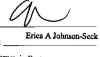
In a sworn deposition in July, Erica Johnson-Seck, an Austin, Tex.,-based vice president for bankruptcy and foreclosure for OneWest Bank, said she and her team of seven others sign 6,000 documents a week or about 24,000 a month without reading all of them.
Johnson-Seck estimated that she spent no more than 30 seconds to sign each document.
She explained that while she does not check everything, she does check some information, “which is why I said 30 seconds instead of two seconds.”
SAN FRANCISCO (Reuters) – An outcry over questionable foreclosures by GMAC Mortgage and other lenders is likely to hit some states more than others because of major differences in real estate law across the nation.
But ramifications for federal taxpayers and investors will depend on the costs of clearing up the problem, the latest fallout from the bursting of the U.S. real estate bubble.
GMAC Mortgage announced last week that it had suspended evictions and post-foreclosure closings in 23 states due to concerns over paperwork. In order for a lender to foreclose on a property, it must prove that it actually checked the borrower’s loan agreements, and that the homeowner defaulted.
But the unit of Ally Financial, which is 56.3 percent owned by the U.S. government after a $17 billion bailout, said employees preparing foreclosures had submitted affidavits to judges containing information they did not personally verify.
“It’s a real mess,” said Justice Arthur Schack, a jurist on foreclosure issues who sits on the New York State Supreme Court in Brooklyn.
GMAC’s announcement has raised doubts about whether some people lost their homes without good reason. Attorneys general in several states, including California, Colorado, Illinois and Ohio, are investigating.
“The law demands that lenders prove their case in foreclosure actions,” Illinois Attorney General Lisa Madigan said last week.
But Ally characterizes the problem as merely technical, arguing that the underlying facts in each foreclosure are accurate.
“We are confident that the processing errors did not result in any inappropriate foreclosures,” it said in a statement last week.
GMAC landed in its predicament after one of its employees testified in a December 2009 deposition that he signed off on tens of thousands of affidavits containing information he did not verify.
The company said it has “substantially increased” the number of employees to verify documents, provided additional training, and suspended evictions out of an “abundance of caution.”
Ally isn’t the only firm under the microscope.
JPMorgan Chase & Co is delaying its current foreclosure proceedings and has begun to systematically re-examine related documents after discovering that some employees may have signed affidavits in some cases without personally reviewing the files.
Lawyers in Florida are questioning JPMorgan’s practices after discovering one of its executives did not check the details of its claims against a homeowner.
The executive said she had been part of an eight-person team that signs 18,000 documents a
SECRETARY BRUNNER OUTLINES TWO LINES OF ATTACK IN FIGHTING HIGH OHIO FORECLOSURE RATES
COLUMBUS, Ohio – Ohio Secretary of State Jennifer Brunner, Ohio’s chief elections officer and the state officer responsible for licensing notary publics, today issued a directive to boards of elections that foreclosures cannot be used without further investigation to disqualify voters and revealed that she has referred specific instances of notary abuse occurring at Chase Home Mortgage in Columbus and by the Mortgage Electronic Registration Systems, Inc. (MERS) to a federal prosecutor for investigation.
DIRECTIVE ON VOTERS FACING FORECLOSURES: Secretary Brunner, in Directive 2010-66, instructed Ohio’s 88 county boards of elections that they may not cancel an Ohioan’s voter registration based solely on the fact that the person is involved in the foreclosure process. The filing of a foreclosure action does not affect a voter’s right to vote until there is a final judgment entry, including the passage of at least 30 days from the date of the entry because of the right of appeal, and verification that the person no longer resides at the property. Ohio continues to experience high residential foreclosure rates.
Those who lose their homes because of foreclosure may wait until Election Day to update their address. Boards are instructed in the directive how to help voters displaced because of foreclosure, based on whether they move (1) within the same precinct, (2) within the same county but to a different precinct, or (3) to a different county in Ohio. Voters facing foreclosure may use their current location of residence as their residence for the purposes of voting.
REFERRAL OF CHASE HOME MORTGAGE AND MORTGAGE ELECTRONIC REGISTRATION SYSTEMS, INC. TO FEDERAL PROSECUTOR: Secretary Brunner, in two letters dated Aug. 11, 2010 and Sept. 1, 2010, referred matters of alleged notary abuse in thousands of home mortgage foreclosures by Chase Home Mortgage and the Mortgage Electronic Registration Systems, Inc. to U.S. District Attorney Steven Dettelbach in Cleveland. Citing two depositions, (one & two) of Chase employee Beth Cottrell, taken in Columbus in May of 2010, and a deposition of MERS Secretary and Treasurer, William Hultman taken in New Jersey in April of 2010. These depositions contain sworn testimony that at Chase Home Mortgage, 18,000 documents per month are executed and notarized per month by eight people, with admissions that:
it is the notary and not the document signer who gives an oath who fills in numbers in the affidavits used in court ordered foreclosures,
no oath is administered for the signing of each document,
notarized documents are not verified by the person signing and giving oath that they have personal knowledge of the contents of the documents, but rather, signers are relying on verification by others,
documents are signed in bulk and notarized in bulk separately,
notaries know this at the time they notarize documents in this process.
The MERS deposition of William Hultman demonstrates that after corporate status changes occurred for MERS, new designations of authority were not executed, leaving one or more individuals for the former MERS corporation continuing to delegate authority on behalf of the new corporation without authorization by the new corporation.
According to its website: “MERS was created by the mortgage banking industry to streamline the mortgage process by using electronic commerce to eliminate paper…MERS acts as nominee in the county land records for the lender and servicer. Any loan registered on the MERS® System is inoculated against future assignments because MERS remains the nominal mortgagee no matter how many times servicing is traded. MERS as original mortgagee (MOM) is approved by Fannie Mae, Freddie Mac, Ginnie Mae, FHA and VA, California and Utah Housing Finance Agencies, as well as all of the major Wall Street rating agencies.”
MERS was created by the mortgage lending industry to:
eliminate frequent re-recording of liens,
avoid paying county recorder fees and other local taxes as mortgage loans are assigned as backing or securitization for derivatives trading by banks and other financial institutions,
monitor and facilitate the transfer of original mortgage notes in the trading of mortgage-backed securities,
foreclose on mortgage notes for unnamed note holders, even though it is not the real financial party in interest and does not hold the original note for the mortgage.
Currently, over half of all new residential mortgage loans in the U.S. are registered with MERS and recorded in county recording offices in MERS’ name, reducing transparency, leaving consumers unable to determine who actually holds the note on their homes.
Secretary Brunner made the following statement on the situation:
“Mortgage foreclosure documents must be notarized according to the law. Requiring this is not an afterthought or an exercise of form over substance—the law must be followed when taking away someone’s home, regardless of the circumstances.
For too long thousands of homes have been taken from consumers without proof that the foreclosing party actually has that right. Our courts must be cautious and require absolute adherence to the law. As the officer in Ohio who licenses notaries, I cannot stand idly by and watch financial institutions concoct a chain of title they never had by abusing the notary process.
It’s not fair to consumers or to the employees who by virtue of their jobs, are signing these documents. I urge the U.S. Department of Justice to take up this investigation with vigor and purpose to protect consumers and hold financial institutions to the standards of scrutiny and exactitude required by law, even if it means prosecuting some of our largest corporations. These apparent violations of state law point to schemes that merit federal investigation of large institution lending practices and use of the U.S. Postal Service.”
Last week, GMAC Mortgage announced it had suspended evictions and post-foreclosure closings in 23 states over concerns about employees preparing foreclosures with affidavits submitted to judges containing information they did not personally verify. Yesterday it was announced that JPMorgan Chase and Co hired external counsel to review its affidavit process based on the depositions of Beth Cottrell and is delaying approximately 56,000 current foreclosure proceedings.
Dear Judge XXXXX, I write you, and the other presiding and administrative judges of the Ohio Courts of Common Pleas, to draw your attention to an issue that may be of interest to you.
As you are aware, when a plaintiff in a foreclosure case moves for default or summary judgment, it will attach an affidavit from the lender or mortgage servicer attesting to the ownership and default status of loan. During the last week, questions have arisen about the validity of the foreclosure affidavits filed by a large servicer, GMAC Mortgage. GMAC (also operating as “Ally Financial”) issued a press release on September 20, 2010 announcing that it had directed certain of its vendors to suspend evictions and REO closings because of “a potential issue that was raised in a number of existing foreclosures challenging the internal procedure we used for executing one or more judicially required forms.”
A number of media outlets, including The Washington Post and The New York Times, reported on this statement. The news articles suggest that GMAC’s actions are related to a Florida deposition and a Maine deposition given by one of its employees, Jeffrey Stephan. Mr. Stephan signed thousands of foreclosure affidavits for GMAC, but in his depositions stated that he does not have knowledge of how the information in the affidavit is determined (Deposition of Jeffrey Stephan, June 7, 2010, p 30), does not know how the accuracy of the information is verified (Id.), does not review the exhibits attached to the affidavit (Id., p 54), does not read every paragraph of the affidavit (Id. p 61), and does not have the affidavit notarized in his presence (Id., p 56).
The depositions were not taken by my office, so I do not opine on their accuracy, but I wanted to draw your attention to this issue. At least one court has found that filing affidavits that falsely claim personal knowledge is a violation of the Ohio Consumer Sales Practices Act when filed in connection with consumer transactions. Midland Funding, LLC v. Brent, 644 F. Supp. 2d 961, 977 (N.D. Ohio, 2009).
More broadly, I urge you as administrators to share this letter with your colleagues and urge them to exercise caution when approving any foreclosure orders involving GMAC. Further, I encourage you to consider whether additional administrative procedures need to be established to protect homeowners who are facing the threat of foreclosure. Issues similar to those surrounding GMAC have arisen in Ohio. For example, my office filed an amicus brief in an appellate case where a foreclosure affidavit averred that it was executed in Florida but the jurat and notarization stated that it was executed in New Jersey. The 2nd District Court of Appeals ruled that the trial court did not abuse its discretion by striking the faulty affidavit. HSBC Bank USA v. Thompson, 2010-Ohio-4158.
Please feel free to contact me or my Consumer Protection Section Chief, Susan Choe, at 614.466.1305, if we can be of any assistance regarding this letter.
Thank you.
Sincerely,
Richard Cordray
Ohio Attorney General
CC:
Sarah Lynn, Deputy Chief Counsel, Ohio Attorney General
Susan Choe, Consumer Protection Section Chief, Ohio Attorney General


















 See full article from DailyFinance: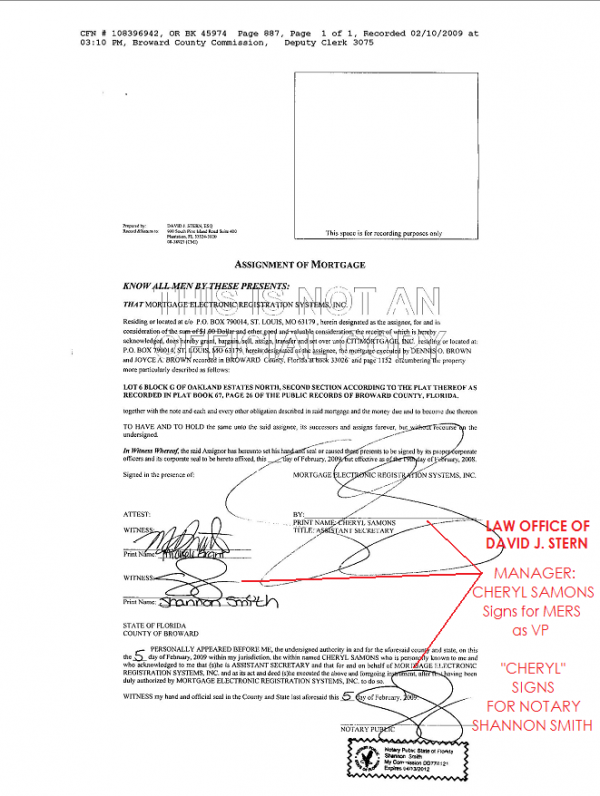















Recent Comments